
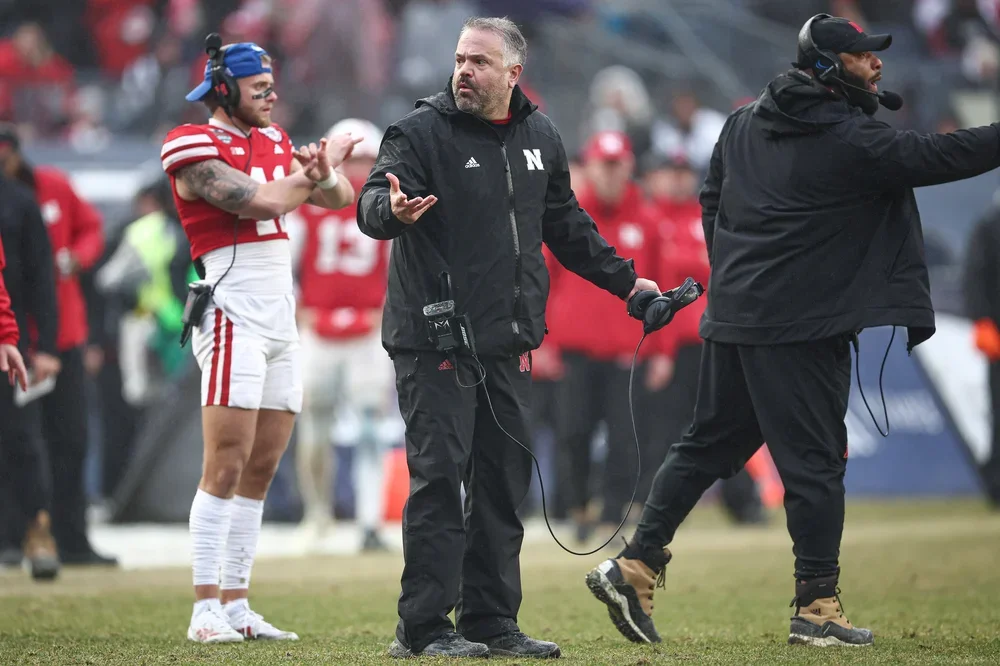
Nebraska’s football program, led by head coach Matt Rhule, suffered a significant defeat in the first major enforcement dispute of the post-House settlement era. On Monday night, the College Sports Commission (CSC) secured a binding arbitration victory against 18 Cornhuskers players who had challenged the commission’s rejection of Name, Image, and Likeness (NIL) deals tied to Playfly, the university’s multimedia rights partner.
What unfolded can be seen as a broken promise. Eighteen young athletes believed they had secured their financial futures with deals valued at over $1 million. However, the new sports authorities stepped in and canceled those payments. The players fought to retain their earnings but lost in a closed-door legal proceeding.
“A neutral arbitrator has issued a final, binding decision affirming the College Sports Commission’s (CSC) application of the rules in connection with third-party NIL agreements between Playfly and student-athletes at the University of Nebraska,” the official statement read. “The neutral arbitrator found that the CSC properly determined that Playfly is an associated entity, and properly determined not to clear the NIL deals at issue based on a lack of a valid business purpose, including a violation of the rule against warehousing NIL rights.”
The rejected deals involved payments through Playfly, which signed a 15-year contract with Nebraska worth over $300 million. In December, the company had reportedly agreed to redirect more than $10 million toward NIL opportunities, including roughly $8 million due by June.
From Nebraska’s perspective, this may have appeared to be a smart business move. Schools across the country are trying to navigate revenue-sharing while keeping their rosters intact. Matt Rhule’s Huskers were simply trying to stay ahead of the curve. But the CSC argued that the structure crossed the line.
According to the ruling, the deals did not involve the sale of real products or services to the public for a legitimate business purpose. The CSC also contended that Playfly was acquiring NIL rights from players without immediately using them, effectively stockpiling those rights for the future rather than creating current NIL opportunities.
The broader concern for the CSC is the precedent such deals could set. If media partners can channel millions of dollars to athletes without strict oversight, schools nationwide might follow suit, rendering the NIL clearinghouse nearly useless. That’s why CSC’s leadership considers this win a crucial step in maintaining the integrity of the system.