
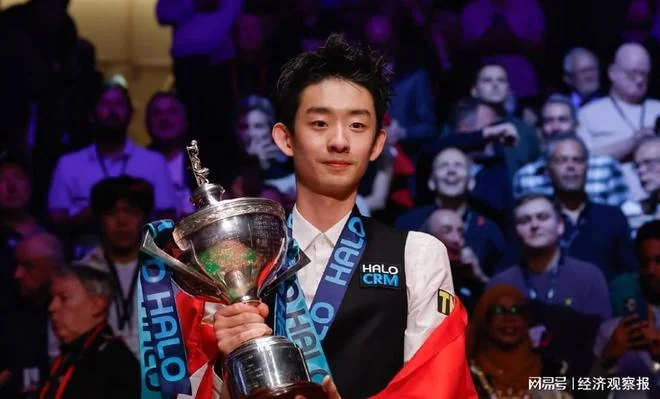
The 2026 World Snooker Championship delivered a historic moment as 22-year-old Chinese star Wu Yize defeated England’s Shaun Murphy 18-17 in a gripping final. This victory makes Wu the second Chinese player to win the world title, following Zhao Xintong’s triumph in the previous year.
Earlier in the tournament, Murphy had eliminated Chinese competitors Fan Zhengyi and Xiao Guodong, as well as defending champion Zhao Xintong in the quarterfinals. The responsibility to stop Murphy fell on Wu Yize, and he rose to the occasion with remarkable composure. As Ding Junhui noted, “From Zhao Xintong to Wu Yize, Chinese players standing atop the world championship podium for two consecutive years is not just a breakthrough—it’s the arrival of our era.”
Zhao Xintong had predicted this shift in an interview earlier in April, stating that snooker would eventually belong to China. He pointed to the growing number of professional Chinese players, built through generations of effort. “In the next 10 to 20 years, perhaps the majority of professional players will be Chinese,” he said.
That assessment is backed by numbers. In the 2025 World Championship, 10 Chinese players qualified for the main draw, with six reaching the last 16. In 2026, 11 Chinese players made the cut, and four advanced to the knockout stage. Moreover, Chinese players represent the sport’s new wave of youth: among the nine players born after 2000 at this year’s championship, only Chinese competitors had previously won ranking events. Seven-time world champion Stephen Hendry observed, “China will become the dominant force in snooker because all the top young talents come from there.”
The foundation for this success was laid by two pioneering figures: Sun Linbo and Ding Junhui. In 1985, Sun Linbo competed against Steve Davis in Guangzhou, and a year later, he became the first Chinese player to win a frame against a world champion, sparking an initial snooker boom. In 2005, Ding Junhui won China’s first major international titles at the China Open and UK Championship, marking what is now called “the first year of Chinese snooker.” Ding’s runner-up finish at the 2016 World Championship was a milestone before Zhao and Wu’s breakthroughs.
Ding has remained an active presence on the international stage, serving as both a trailblazer and mentor. Zhao Xintong received guidance from Ding, while Wu Yize trained at Ding’s snooker academy as a teenager. This lineage reflects the passing of the torch across generations. Despite Ding’s exit at the hands of Zhao in this year’s tournament, the rise of younger Chinese players provides reason for optimism.
The broader support system is also expanding. China’s pool and snooker participation has grown from 60 million in 2011 to over 80 million today, with nearly 300,000 clubs nationwide. Both Zhao and Wu emerged from grassroots beginnings on street tables, illustrating the depth of this foundation.
After his stunning victory, Wu Yize thanked his parents, calling them the “true champions.” His family sold their antique shop and only home to fund his professional training when his talent became apparent—a gamble that turned a young boy from Lanzhou, once seen as chasing an unconventional dream, into a world champion. While such a singular commitment is rare, it underscores the extraordinary opportunities now available within China’s flourishing snooker ecosystem.
The center of gravity in snooker has clearly shifted eastward. Tournaments are now held across Chinese cities from Beijing and Shanghai to smaller towns like Yushan, drawing global attention. The number of ranking events has risen to nearly 20, compared to just six two decades ago, bolstered by China’s massive market. World Snooker Tour chairman Jason Ferguson acknowledged, “China is writing its own history—snooker is no longer just a British sport but truly global.” Legendary player John Higgins added, “Every snooker player benefits from China’s market potential.”
In this light, two consecutive Chinese world titles are neither accidental nor miraculous. They are the natural result of sustained development and investment. The future promises even more young Chinese players reaching the pinnacle of the sport.